
Grant Update
Planting a Matrix Designed Garden in the Fall at the Ostermeier Demonstration Garden

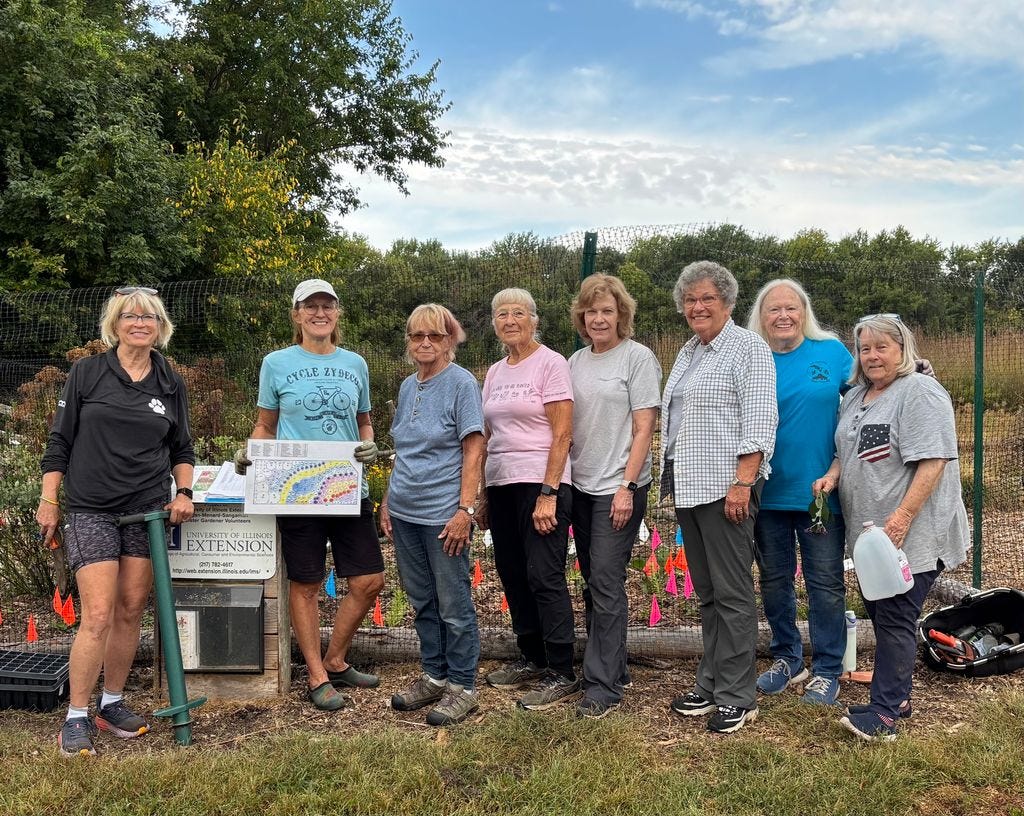
Final report submitted by Donna Holinga and Karla Frank
The Ostermeier Demonstration Garden, a project of Lincoln Memorial Garden in partnership with University of Illinois Extension, was first planted in the Spring of 2013 by a committee of University of Illinois Extension Master Gardeners and Master Naturalists. Plants were spaced wide enough apart so that the public could easily see each flowering plant which was identified with a label. In the spring of 2025, the committee became interested in remodeling the Southeast quadrant of the garden to demonstrate the most current method of native garden design. This Matrix Garden Design style required adding many additional forbs, sedges and grasses while keeping several of the existing plants. Unlike the other three quadrants of the garden, we placed the new forbs close together in drifts and planted the sedges and grasses between the flowering plants as a “green” mulch. Thanks to a grant from Illinois Native Plant Society, Central Chapter native plants were purchased from 3B Natives Plant Nursery and The Bee’s Knees Nursery; others were donated by committee members and Alana McKean. We wanted to demonstrate the benefits of planting in the fall: increased root development due to warmer soil temperatures, more consistent rainfall meaning less watering, fewer insects and less weeding because grasses and weeds start to die out in the cooler temperatures. This leads to stronger plants in the spring and less garden maintenance. We hope to educate the public about the value of using the matrix design in a home landscape and fall planting to improve garden success, reduce garden maintenance and to create a beautiful garden which will benefit the environment.


On September 17, 2025, we began work on the Southeast quadrant by relocating existing forbs that did not fit into our garden design to other quadrants in the Ostermeier Demonstration Garden. The ground in the Southeast quadrant had been mulched and the committee kept it weed free, so soil preparation was minimal. We put up a fence to keep the deer and rabbits out of the newly planted quadrant of the garden and marked where the flowering plants were to be planted with labeled flag markers. On September 19,
2025, 118 forbs were planted. Since the plants were placed so close together three committee members arrived before the rest of the group and dug the holes for the new plants. Then, the remainder of the group arrived and planted the new forbs. In addition, we marked where the Stout Blue Eyed Grasses and Wild Petunia plants were to be planted. On October 1, 2025, we planted the Stout Blue Eyed Grass and Wild Petunias. We contacted several native plant nurseries but were unable to purchase the Pennsylvania Sedge at this time because it was dormant or supplies were sold out. It has been pre-purchased and reserved with the Bee’s Knees Nursery and will be planted in the spring. We have received very little rain since September 17th; therefore, we set up a watering schedule. Committee members watered the new plants deeply twice a week for 3 weeks. We hope with cooler temperatures we can reduce the watering to once a week. However, we continue to monitor plants for signs of stress.


146 new forbs and grasses were added to the Southeast Quadrant of the Ostermeier Demonstration Garden. The fence we installed has kept the deer and rabbits from eating our plants. Routine watering has kept our plants looking healthy during unseasonably warm temperatures and lack of rain. 25 Pennsylvania Sedge plants will be added to the quadrant in the spring. Discussion: One of reasons the ODG committee decided to redesign the Southeast Quadrant of the Ostermeier Demonstration Garden in September was to demonstrate to the public the advantages of planting in the fall as opposed to planting in the spring. This fall has been unseasonably warm and dry. However, we feel our new plants have benefited from cooler morning and night temperatures, but warmer soil temperatures. Also, we have not had to deal with weeds which has decreased maintenance. Although we did not get the moisture typically expected in the fall, we still feel fall planting will prove beneficial because the plants will already be in the ground putting down roots and ready to grow when the spring warm-up begins.
Thanks to this grant from Illinois Native Plant Society, Central Chapter we were able to purchase native plants, grasses and sedges to redesign the Southeast Quadrant of the Ostermeier Demonstration Garden utilizing a Matrix Garden Design. Each year in September our committee presents a program, Creating a Native Garden from Scratch and a Matrix Garden Design Workshop in late winter. We look forward to highlighting our fall planted Matrix Garden Design quadrant and crediting the INPS Central Chapter grant funding in our up-coming programs.
Editor’s note: Find more information about the next event the native garden design series here.
This project was supported by the Central Chapter Grant Program, which provides up to $1,000 to support efforts that promote the conservation of Illinois native plants and natural communities. If you or someone you know has a project idea, now is the perfect time to apply—details are available here: 🔗 Central Chapter Grant Info